By: Hong Ta
SESEC’s advocacy priorities include advocating for a restorative youth practice, which shifts from a policing-based model of school safety to one rooted in racial justice, community care, and positive school culture. The Recipes of Success Program is a prime example of restorative programming aimed at supporting BIPOC students disproportionately impacted by punitive practices. We are highlighting this program in the Southeast Seattle community to spread awareness using our Strategies that Work series.
All Interagency Academy students now have access to the Recipes for Success Program, a food education and cooking class series that equips scholars with the tools to succeed in cooking, both professionally and personally, while earning high school class credit.
In Spring 2025, the pilot project of Recipes for Success was a partnership between Solid Ground Community Food Education, PCC Community Markets, Organically Grown, and the southeast campus of Interagency Academy. Students received their food handler certification and learned how to cook culturally relevant meals in their own homes. PCC Community Markets provided a commercial kitchen in Southeast Seattle and provided food and supplies for students to utilize.
The second iteration of the program was open to all students at the Interagency Academy campuses.
Interagency Academy is an Alternative Learning Environment (ALE) Program that provides students with access to resources otherwise unavailable in traditional schools. The Southeast Campus is located in the Sugiyama building on Rainier Avenue. Other campuses include the Southwest Campus, Children and Family Justice Center, King County Jail, and more.
There are a total of six campus locations throughout Seattle, along with a virtual campus and a clean-and-sober/recovery campus. SPS prioritizes enrollment for underserved students, including those who have experienced trauma and school-related trauma, identify as BIPOC, identify as LGBTQIA+, are employed full-time, have parental/family care responsibilities, and experience neurodiversity or mental health conditions.
Michael Friedman is Solid Ground’s Community Food Education Program Manager and currently oversees the Recipes for Success program. He is a classically trained chef from the East Coast and began at Solid Ground in the late 1990’s as a volunteer chef instructor for cooking classes.
“It’s kind of poetic that I’m actually back now, managing the program where I used to volunteer. I’ve always worked around food for many, many years. Wow. But this seems like the perfect culmination of all of my loves and passions that have brought me to where I am now,” said Friedman.
Friedman is also the Solid Ground representative on the Seattle School Meals & Food Education Working Group, whose goals include supporting high-quality school meals and food and garden education for students. The Group includes government agencies, such as the City of Seattle’s Office of Sustainability & Environment, Seattle Public Schools and community-based organizations, such as the Southeast Seattle Education Coalition.
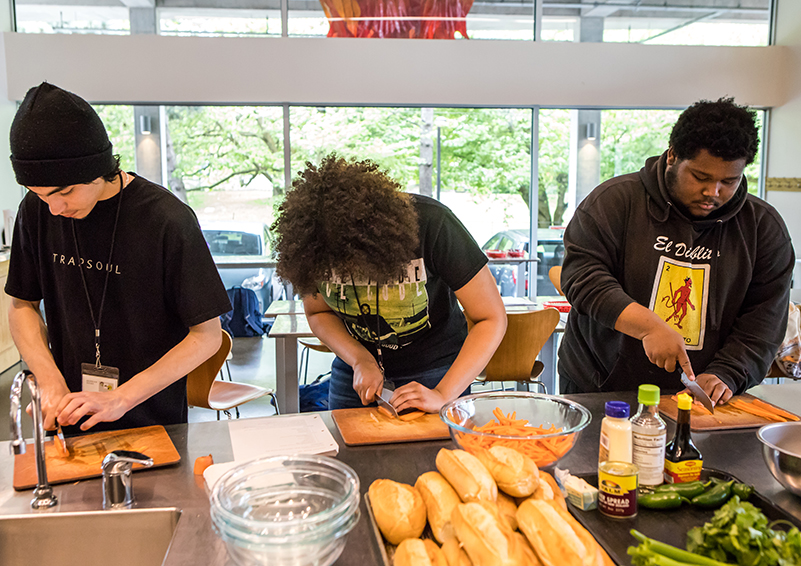
Recipes for Success also partners with many organizations in order to support student participants to get credit, which opens up opportunities to grow the reach for the program.
“It’s a really powerful partnership. Now that we are able to get school credit with our curriculum, I think that opens it up, and it really becomes desirable, I think, for school districts. and are looking for ways to engage students and to offer different paths to graduate,” said Friedman.
In the future, Friedman hopes to integrate more experiential and restorative learning opportunities for students.
“We talked about maybe even doing like an internship or a practicum afterward where they could work in bakeries or groceries or on farms or all different parts of the food system, said Friedman. “What it would look like to show them what’s out there once you start with job training, at that point, you’re really transforming lives, right? You’re helping people get out of cycles in their lives to show them that there’s hope and show them there’s another way.”
Solid Ground is currently planning Recipes for Success for the next academic year. It will be their third series partnering with PCC Community Markets and Interagency Academy.
They are also excited to be working on an expansion of the program, which is being discussed to take place at Rainier Valley Food Bank, utilizing their new facility and its commercial-style kitchen, which they have been hoping to use to partner with other community organizations. Solid Ground will be looking to recruit students from Rainier Beach High School for these classes.
Pubic, private and nonprofit partnerships should focus on restorative programming priorities. Initiatives such as Recipes for Success are part of the holistic strategies for keeping youth safe in our community and are a crucial example of restorative programs that should be replicated and expanded upon in Southeast Seattle.
Author: Hong Ta is the Marketing and Communications Coordinator at the Southeast Seattle Education Coalition. Have a suggestion for our Strategies that Work series? Email her at [email protected].