What are the impacts on schools, especially students and teachers, of sanctuary city policies? What are the learnings and needs for schools related to sanctuary city policies?
2026 has signified the aggressive movement of the Trump administration towards the federalization of white supremacy. We saw this throughout last year and 2026 with the mass kidnapping of people of color throughout the country. The movement was crystallized in the murder of Renee Goode and Alex Pretti in Greater Minneapolis, Minnesota. The state-sanctioned ethnic cleansing and killings of U.S. citizens reflect the administration’s push to embed white supremacist values and practices directly into the umbrella of the executive branch that can live beyond the 2nd Trump administration.
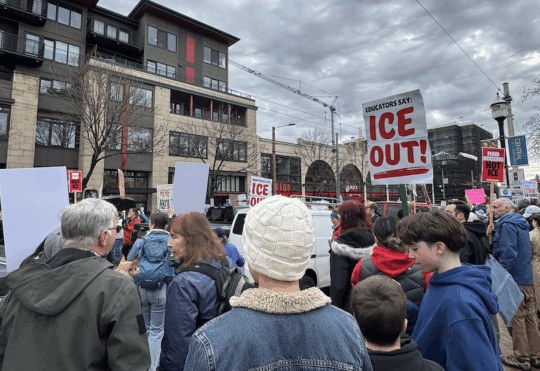
Washington and Seattle have experienced a large number of arrests and encounters with ICE since the beginning of Trump’s 2nd administration. In the first 10 months of the administration, nearly 2,000 people have been arrested by ICE, with nearly 90 young people being taken to custody by ICE. This does not account for the number of encounters people have had with ICE, particularly in 2026. SPS school communities were also directly disrupted when ICE activity was reported, and schools, specifically southeast Seattle schools were under shelter-in-place protocol (Aki Kurose Middle School, Cleveland High School, Maple Elementary and Mercer Middle School). The perpetuation of white supremacy is dependent on publicity of violence and harm, which is evident in our school communities when educators, families, and community organizers speak to how youth and families are scared to go out in public, which we see in our SE Seattle school communities. Not only is learning and growing disrupted, but also the right to live and the “pursuit of happiness”.
We saw the early stages of this playbook of whitewashing during Trump’s 1st administration. Many major cities during that time, such as Chicago and Seattle, responded to the persecution of non-English speakers, migrants, and people of color disguised as immigration enforcement through “sanctuary city” policies (City of Seattle makes a point to call themselves and their policy “Welcoming City”). The designation of a city as a “sanctuary” generally means that the city’s governance does not or limits cooperation and engagement with federal actions concerning immigration enforcement, such as involving local law enforcement. Local opposition and strategic action against the federal government reflect the delicate and fragile checks and balances of the U.S. and the structures of federalism.
The strategy of sanctuary city designation is an important action and initial step towards protecting against white supremacist tyranny and federal overreach. However, sanctuary designations are largely reactive to federal actions and do little to create a comprehensive policy that addresses immigration issues and supports the lives and communities of immigrants and migrants.
This strategy has direct and deep implications for education systems, schools, and local stakeholders. In SPS, there have been various instances of ICE mobilization in school communities that have disrupted learning and community well-being. In speaking with teachers in Southside Chicago, Black teachers are also expressing the greater impact of sanctuary city policies in schools, teaching, and student learning. While their experiences are unique to Southside Chicago, there are takeaways that should be considered for King County, the City of Seattle, and Seattle Public Schools.
Miles Elementary (pseudonym for a K-8 school in Southside Chicago) is situated in a historically Black middle-class neighborhood, and the school has been a beacon of Black excellence. While much has changed at the school and in the broader school community/neighborhood, teachers at Miles are now noting changes among the families and students attending the school. Miles now has a small handful of newcomer students, particularly from South America. Previously, nearly all of Miles’s students and families were Black (including African immigrants).
Newcomer students at Miles are experiencing schooling in the U.S. for the first time, and for some, for the first time in schools altogether. Miles teachers are experiencing for the first time teaching students who do not look like them, speak their language, or reflect their life experiences. Many of the teachers have embraced their newcomer students and families, the pedagogical challenge of reaching new student populations, and collaborated with other educators to best serve newcomer students.
However, the district has done little to support Miles’ teachers in this new teaching context, let alone adequately serve newcomer students. Miles teachers did not receive any professional development or training, bilingual or ELL staffing, nor other direct resources (for example, expanded language versions of curriculum). What those teachers got was a webpage they had to self-navigate for resources. Teachers relied heavily on translation apps and programs to adapt their work and communicate directly with newcomer students. The lack of resourcing also meant teachers had to rely heavily on others, specifically the school’s Spanish teacher and another Spanish-speaking teacher (a 5th-6th-grade teacher). The 2 Spanish-speaking teachers were stretching themselves tremendously to support the teachers and the newcomers.
Some newcomers found it easier to adjust to school at Miles than others. Those in primary grades or with prior schooling experience in their home country were able to adjust more easily over time. Students who were older, especially those without prior schooling experience, found it difficult to adjust, and teachers were challenged in supporting their learning and growth.
Miles teachers generally embraced and loved their newcomer students. The teachers were honest in their evaluation of inequities at Miles when they noted how newcomer students are not adequately resourced and thus served. These teachers identified a disconnect between the City of Chicago and the school district, where city governance did not coordinate with the school district on the impact of the sanctuary designation and how schools should prepare for it in the long term.
Seattle is in a unique and opportune position, as the city and the school district have undergone major leadership changes in a similar time frame, with Mayor Wilson and Superintendent Shuldiner taking the helm. Currently, the City of Seattle and SPS have policies in place that outline where they largely stand on immigration enforcement. Their policies outline how the City and SPS will operate or make decisions when it comes to immigration enforcement being involved in Seattle or schools, and how constituents should navigate circumstances involving immigration enforcement. However, the two policies are not in conversation with each other, meaning that the City and SPS are not collaborating on this issue of federal overreach. The City has created many policies and advocacy work to protect and assist immigrants, but none of them are in collaboration with SPS. My learnings from teachers in Chicago, SE Seattle family leaders, and the SESEC coalition are that collaboration, partnership, and synchronization are required across various systems in order to resist against federalization of white supremacy, protect our vulnerable and marginalized communities, and most importantly, create a city and schools for the future.
White supremacy in government isn’t going anywhere, demographics will always evolve, and yet basic needs will largely remain the same. How will the City of Seattle and Seattle Public Schools (with King County and others) coordinate, collaborate, and communicate to best resource schools for all dynamic changes in school communities and to be responsive and resilient in making education equitable?
Author biography: